In the manga
In SIGNAL 4, with Teru there to listen, Ikune-senpai is even more fired up than usual.

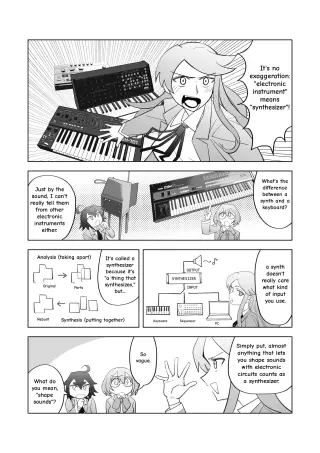
It’s no exaggeration: “electronic instrument” means “synthesizer”!

What’s the difference between a synth and a keyboard?

Just by the sound, I can’t really tell them from other electronic instruments either.
Teru and Kohaku have a point. Let’s follow Senpai’s explanation and find out what a synthesizer really is.
A synthesizer is “a thing that synthesizes”
It’s called a synthesizer because it’s “a thing that synthesizes,” but…
Synthesis means “putting together” or “combining.” Its opposite is analysis, “taking apart” or “examining.” As in the diagram in the manga, analysis splits one whole thing into its parts, and synthesis combines the parts to rebuild the original.
Analysis (taking apart)
Synthesis (putting together)
In LESSON 03 we saw how Helmholtz used resonators to split sounds into harmonics and study them (analysis). A synthesizer is a machine that goes the other way. It makes the elements of sound with electronic circuits and combines them to create the sound you are aiming for.
It doesn’t matter how you play it
A synth doesn’t really care what kind of input you use.
With or without a keyboard, played automatically by a sequencer (see LESSON 09), or controlled from a computer, a synthesizer is still a synthesizer. As we saw in LESSON 01, that is because in an electronic instrument the circuit that makes the sound is separate from the part you play. So “synth” does not mean “keyboard instrument.”
Simply put, almost anything that lets you shape sounds with electronic circuits counts as a synthesizer.
Teru’s verdict: “So vague.” But Senpai then adds something important.
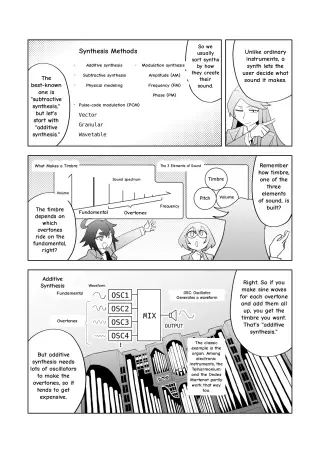
Unlike ordinary instruments, a synth lets the user decide what sound it makes. So we usually sort synths by how they create their sound.
A piano always has the timbre of a piano, and a violin the timbre of a violin. With a synthesizer, the player creates the timbre itself. That is why synthesizers are usually sorted not by how they look or how you play them, but by how they create their timbre (the synthesis method).
All kinds of synthesis methods
Here are the methods Senpai wrote on the blackboard, each in a sentence or two.
- Additive synthesisBuild a sound by adding sine waves together.This lesson →
- Subtractive synthesisStart from a wave full of harmonics and carve away the ones you don’t want.LESSON 06 →
- Physical modelingRecreate, by calculation, the way a string or a pipe actually vibrates.
- Modulation synthesis (AM, FM, PM)Shake a sound with another sound to create new harmonics.LESSON 07 →
- PCM and its relativesPlay back recorded waveforms. Wavetable synthesis, which switches from waveform to waveform, and granular synthesis, which chops sound into tiny grains, also grew from here.LESSON 08 →
“The best-known one is ‘subtractive synthesis,’ but let’s start with ‘additive synthesis,’” Senpai says, and begins with the most straightforward method.
Additive synthesis: building by adding
Senpai asks, “Remember how timbre, one of the three elements of sound, is built?” Kohaku thinks back to what she looked up on her own and answers.
The timbre depends on which overtones ride on the fundamental, right?
Right. So if you make sine waves for each overtone and add them all up, you get the timbre you want. That’s “additive synthesis.”
An oscillator (OSC) is a circuit that generates a waveform. In additive synthesis you line up one oscillator making a sine wave for the fundamental and more oscillators making the harmonics at 2×, 3× and so on, set the level of each, and add them together. In theory, as long as you know the lineup of harmonics, you can make any timbre at all.
Build a timbre with additive synthesis and play it
This makes sound. Start with the volume low.Waveform (sum)Time →
SpectrumFrequency →
Oscillators per note: 1. Notes playing: 0. Total oscillators: 0.
Shape the timbre with the sliders, then play it on the keyboard (or the A–K keys on a computer). Press a chord and watch the number of oscillators you need keep climbing.
The organ got there first
Senpai goes on: “The classic example is the organ. Among electronic instruments, the Telharmonium and the Ondes Martenot partly work that way too.”
A pipe organ has levers called “stops.” Pull one out and another rank of pipes at a different pitch starts to sound. Stops are marked with pipe lengths such as “8 foot,” “4 foot” and “2⅔ foot.” If 8 foot is the fundamental, 4 foot sounds at twice its frequency and 2⅔ foot at three times. Combining stops is exactly the same as building a timbre by adding harmonics.
The Hammond organ, which appeared in 1935, also sets the mix of fundamental and harmonics by how far you pull out its nine “drawbars.” Its sound comes from the same tonewheels as the Telharmonium’s (see LESSON 04).
The weak spot of additive synthesis
But additive synthesis needs lots of oscillators to make the overtones, so it tends to get expensive.
As the numbers in the demo above show, a timbre that uses 10 harmonics needs 10 oscillators for a single note, and 30 for a three-note chord. On top of that, the timbre of a real instrument changes over time (see LESSON 03), so for realism you would also need a way to move the level of every single harmonic over time. Back when circuits were built by wiring parts together one by one, this was far out of reach.
So turn the idea around. Make one wave that is full of harmonics from the start, then create a timbre by carving away the harmonics you don’t want. That is subtractive synthesis, the one Senpai called “the best-known.”
The birth of the synthesizer
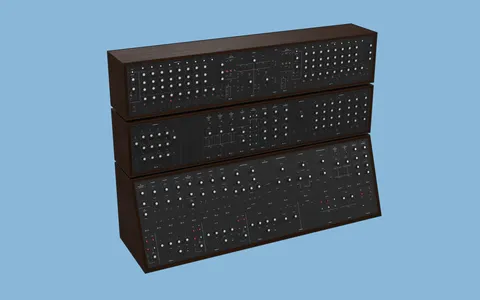
After the vacuum tubes of LESSON 04, small, sturdy transistors spread, and it became possible to split a sound-making circuit into parts and combine them. In the mid-1960s, Robert Moog in the United States began selling the modular synthesizer, which put circuits such as oscillators, filters and amplifiers into separate boxes (modules) that you could connect any way you liked with cables. The big piece of gear under the cloth in the club room is one of these modular synthesizers too.
This idea of “creating timbres by rewiring circuits” is the foundation of subtractive synthesis, in the next lesson.
Summary
- A synthesizer is “a thing that synthesizes (puts together).” It is an instrument that lets you create timbres with electronic circuits.
- How you play it doesn’t matter. Synths are sorted by how they create timbre (the synthesis method).
- Additive synthesis makes sine waves for the fundamental and harmonics with oscillators and adds them up. It can make any timbre, but it needs a lot of oscillators.
- Organ stops and drawbars work on the same idea as additive synthesis.