
In the manga
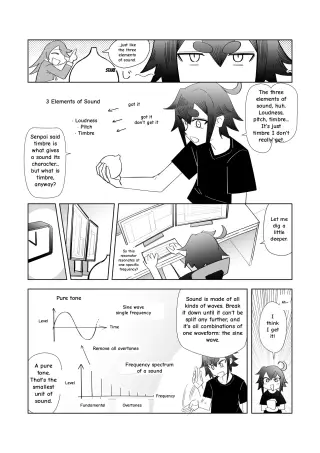
On the night of SIGNAL 2, Kohaku gazes at the “Helmholtz resonator” Senpai gave her and thinks back on what she heard in the club room (LESSON 02).

The three elements of sound, huh. Loudness, pitch, timbre… It’s just timbre I don’t really get.
Kohaku starts looking things up on her computer, and before long she reaches the answer.
Sound is made of all kinds of waves. Break it down until it can’t be split any further, and it’s all combinations of one waveform: the sine wave.
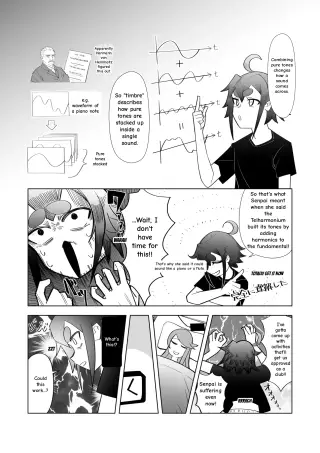
So “timbre” describes how pure tones are stacked up inside a single sound.
In this lesson, we’ll check the answer Kohaku found, with figures and with sound.
The simplest sound: the “pure tone”
A wave that just swings smoothly back and forth, like a playground swing or a pendulum, is called a sine wave. It has only one frequency, which makes it the simplest wave there is. A sound made of nothing but a sine wave is called a pure tone, and it sounds like a plain, straight “beep.” The tone you hear in a hearing test is exactly this, and a tuning fork comes pretty close to a pure tone too.
As Kohaku puts it, “That’s the smallest unit of sound”: a pure tone can’t be split any further.
An instrument’s sound is pure tones stacked together
Take the sound of an instrument with a clear pitch, like a piano or a guitar, break it down finely, and you find many pure tones stacked on top of each other. The lowest one is called the fundamental, and it sets the pitch of the sound. On top of it sit pure tones at exactly 2, 3, 4… times the fundamental’s frequency, and these are called harmonics.
Line up the pure tones a sound contains as bars, with frequency running across and level running up, as in the figure on the right, and you have a spectrum. The “frequency spectrum of a sound” that Kohaku draws in the manga is one of these. In a waveform, timbre only showed up as a difference in shape; in a spectrum it appears clearly as a row of bars, telling you “which harmonics are in it, and how strong each one is.”
All the components above the fundamental are known collectively as overtones. In string and wind instruments the overtones line up at almost exact whole-number multiples, so it’s fine to call them harmonics. In the sound of a bell or a metal plate, the overtones drift away from whole-number multiples, which gives a distinctive ring whose pitch is hard to pin down.
Try stacking them yourself
In the demo below, each vertical slider is one sine wave. First play it with “Pure tone,” then raise the sliders one at a time. The pitch stays the same, but you’ll hear the timbre change more and more.
Build a timbre from sine waves
This makes sound. Start with the volume low.Waveform (sum)Time →
SpectrumFrequency →
Each vertical slider is one sine wave: from the left, the fundamental, then 2×, 3×… its frequency. Move a slider and the waveform and the timbre change together.
- Toward sawtooth: every harmonic, 2×, 3× and so on, each one a little quieter than the last. A bright, buzzing sound.
- Toward square: only the odd-numbered harmonics. A hollow sound, like a woodwind or an old game console.
- Organ-like: organs, too, build their timbres by stacking up many pipes or sound sources.
Sawtooth and square waves are waves that synthesizers use all the time. Both are rich in harmonics, and in LESSON 06 (Subtractive Synthesis) they play a big part as the “raw material before carving.”
Helmholtz and his resonators
Hermann von Helmholtz, who turns up in Kohaku’s research, was a 19th-century German scientist. In his 1863 book On the Sensations of Tone, he showed by experiment that timbre is decided by how the harmonics are mixed in.
What he used for this was the Helmholtz resonator, the very thing Senpai gave Kohaku. It’s a hollow sphere with an opening, and each size resonates strongly at just one particular frequency. Hold the smaller hole to your ear while an instrument plays, and the resonator starts to sound only when a harmonic at its frequency is present. Line up resonators of different sizes, and you have a spectrum display for the ears, one that picks a sound apart harmonic by harmonic.
Helmholtz also went the other way: he lined up tuning forks kept ringing by electromagnets and changed how they were mixed, making sounds close to vowels like “ah” and “oh.” Taking a sound apart to study it (analysis), and putting it together to create it (synthesis): these two ideas are where the word “synthesizer” comes from, as we’ll see in LESSON 05 (Synthesizers and Additive Synthesis).
Before that, the mathematician Fourier had already shown that “any repeating wave can be written as a sum of sine waves.” Helmholtz’s idea was that our ears hear sound the same way, splitting it into harmonics.
Timbre changes over time, too
The timbre of a real instrument isn’t decided by its row of harmonics alone. A piano note contains lots of harmonics at the instant the key is struck, and the higher the harmonic, the sooner it dies away. In fact, if you cut off that first moment and listen, it becomes hard to tell it’s a piano at all. Timbre covers not only “which harmonics” but also “how they change over time.” The part that creates this change over time (the envelope) appears in LESSON 06.
What the Telharmonium was doing
Now that she understands harmonics, Kohaku connects them to what Senpai told her in SIGNAL 1.
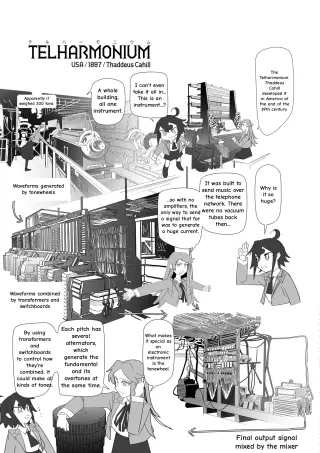
So that’s what Senpai meant when she said the Telharmonium built its tones by adding harmonics to the fundamental!
For each single pitch, the Telharmonium spun several generators, one for the fundamental and others for the harmonics, and made its tones by changing how they were mixed (SIGNAL1 p.15). Picture each slider in the demo above as one giant generator, and you can imagine what a huge job that was.
Summary
- A pure tone (sine wave) has just one frequency. It’s the simplest sound there is.
- An instrument’s sound is made of pure tones stacked together: the fundamental and its harmonics (overtones).
- The fundamental sets the pitch, and the pattern of harmonics sets the timbre. A spectrum shows this clearly.
- Timbre also depends on how the harmonics change over time.