In the manga
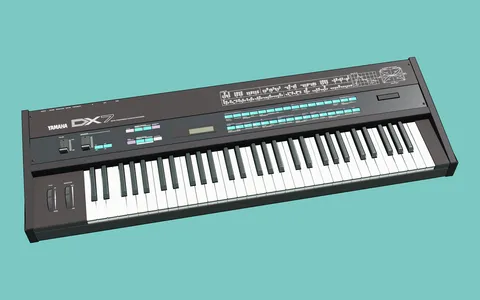
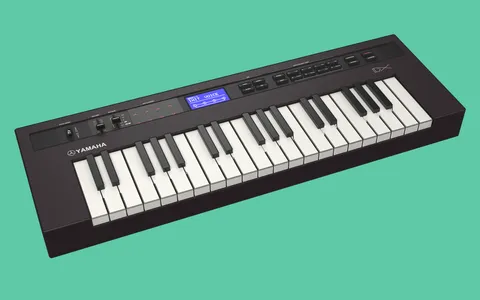
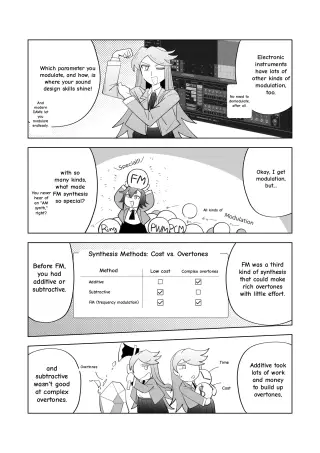
In SIGNAL 7, a Yamaha DX7 arrives in the club room. Released in 1983, it’s the synthesizer that made the name “FM synthesis” known all over the world. Kohaku has a question right away.

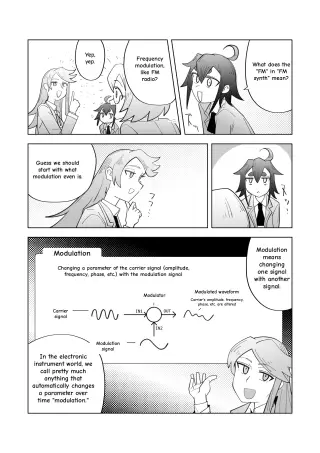
What does the “FM” in “FM synth” mean?
To the question “Frequency modulation, like FM radio?” Ikune-senpai nods, “Yep, yep,” and begins like this.

Guess we should start with what modulation even is.
Modulation: shaking a sound with a sound
Modulation means changing one signal with another signal.
The signal that gets wobbled is called the carrier, and the signal doing the wobbling is called the modulator. The name changes depending on which part of the carrier you wobble.
- Wobble its size (amplitude): amplitude modulation (AM)
- Wobble its height (frequency): frequency modulation (FM)
- Wobble the wave’s position (phase): phase modulation (PM)
The AM and FM on a radio are the same words. In radio, a voice or music (the modulator) rides on a radio wave far too high to hear (the carrier) so it can travel a long way, and the receiver pulls the original voice back out (demodulation). With electronic instruments, the wobbled result itself is what you listen to. As Senpai says, there’s “no need to demodulate,” so you’re free to try any kind of wobbling you like.
In the electronic instrument world, we call pretty much anything that automatically changes a parameter over time “modulation.”
Synthesizers often have a slow oscillator that exists only to wobble things: the LFO (low-frequency oscillator). The envelope from LESSON 06 also moves a parameter over time, so in a broad sense it belongs to the modulation family too.
Vibrato and tremolo
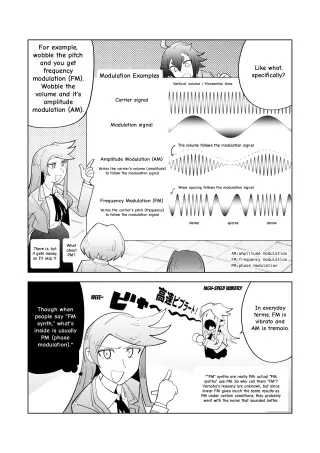
Like what, specifically?
For example, wobble the pitch and you get frequency modulation (FM). Wobble the volume and it’s amplitude modulation (AM). In everyday terms, FM is vibrato and AM is tremolo.
Vibrato is when a singer makes a held note waver (a wobble in pitch), and tremolo is when something like a guitar amp turns the volume up and down over and over (a wobble in loudness). When the modulator is slow (a few times a second), your ear hears it as a “wobble.”
Wobble fast enough, and it becomes timbre
So what happens if you make the modulator faster and faster? Somewhere past 20 times a second, your ear can’t follow the wobble anymore, and instead it starts to sound as if the timbre has changed. The wobble turns into new frequency components (something like harmonics).
Try it in the demo below.
- Press “Vibrato” to play it, then raise “Mod rate” a little at a time.
- Watch the spectrum while you raise and lower “Mod depth.” The deeper it goes, the more bars appear and the brighter the sound gets.
- Listen to “Bright” and “Metallic” and compare them.
Wobble a sound with a sound (AM and FM)
This makes sound. Start with the volume low.WaveformTime →
Spectrumup to 5000 Hz
Speed up the modulator and, from around 20 Hz, you stop hearing a wobble and start hearing a change in timbre. In FM, set the speed to a whole-number multiple of the carrier and neat harmonics line up.
The components you get from FM line up on both sides of the carrier frequency, spaced apart by the modulator frequency. Set the modulator to a whole-number multiple of the carrier, like exactly 1× or 2×, and the components fall neatly on the harmonic positions, giving instrument-like sounds such as brass or bass. Use an in-between number like 1.41×, and the components land off the harmonic positions, giving the bell-like, metallic ring we saw in LESSON 03. And the modulation depth decides how far the components spread out, in other words how bright the sound is.
What made FM synthesis special?
Senpai mentions that “electronic instruments have lots of other kinds of modulation, too,” but something bugs Kohaku.
With so many kinds, what made FM synthesis so special? You never hear of an “AM synth,” right?
Good catch. If you AM a sine wave with a sine wave, you get only two new components, one on each side of the carrier. That’s not much to build a timbre from. With FM, though, the deeper you go, the more components keep appearing, one after another.
FM was a third kind of synthesis that could make rich overtones with little effort.
| Method | Cheap | Overtones | In short |
|---|---|---|---|
| Additive | ✗ | ✓ | One oscillator per harmonic. Takes a lot of work and money |
| Subtractive | ✓ | ✗ | Cheap to build, but can’t make complex harmonic content the original wave lacks |
| FM | ✓ | ✓ | Rich overtones from as few as two oscillators |
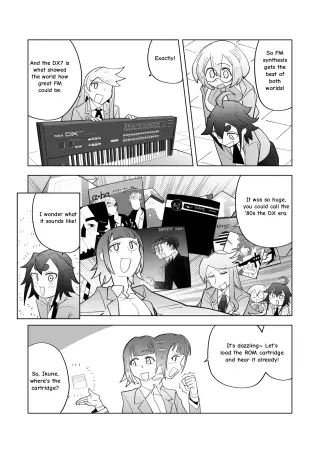
Additive synthesis (LESSON 05) took a lot of work and money to make harmonics, and subtractive synthesis (LESSON 06) wasn’t good at making complex harmonics that weren’t in the original wave. FM can produce lots of harmonics with just two oscillators that make sine waves. When Teru says, “So FM synthesis gets the best of both worlds!” Senpai answers, “Exactly!”
The DX7 and its operators
The idea of using FM to make sounds came from research by John Chowning at Stanford University in the US, and Yamaha turned it into an instrument. The DX7 has six operators that each make a sine wave. You pick which operators wobble which from 32 combinations (algorithms), and each operator gets its own envelope.
If an envelope moves the modulation depth, you can make a sound that has lots of harmonics only at the moment you play it, then slowly gets rounder. It recreates the idea from LESSON 03, “on a piano, the higher harmonics fade sooner,” just as it is. The DX7’s sparkling electric pianos and bells filled the music of the time, so much that the two senpai say “you could call the ’80s the DX era.”
On the other hand, unlike subtractive synthesis, where it’s easy to imagine what turning a knob will do, FM is known for being hard to program: it’s hard to predict how the sound will change when you change a value. In the manga, too, the DX7’s built-in sounds have been wiped, and there’s a scene where they try to load sounds from a ROM cartridge. Buying cartridges of sounds made by the manufacturer or by other people was a perfectly normal way to enjoy a synth back then.
Inside an “FM” synth is PM
Though when people say “FM synth,” what’s inside is usually PM (phase modulation).
As the footnote in the manga says, most “FM synths” actually wobble the phase, not the frequency. Phase is the “position” of a wave: where it is within one cycle. Rock that position back and forth, and the wave gets squeezed and stretched, so the frequency ends up wobbling too.
When a sine wave wobbles a sine wave, FM and PM give almost the same sound once you convert the depth. In digital circuits, wobbling the phase is easier to calculate, and the pitch is less likely to drift when you add modulation, so they build it with PM and call it FM. Senpai skipped this part because “it gets messy,” and it’s enough to remember the bit of trivia that the name and what’s inside are different.
Summary
- Modulation means changing a parameter of one signal (the carrier) with another signal (the modulator).
- Wobble the volume and you get AM (tremolo); wobble the pitch and you get FM (vibrato).
- Speed up the modulator and the wobble turns into new components, so the timbre changes.
- FM is a “third kind of synthesis” that makes rich overtones from few oscillators. What’s inside an FM synth is usually PM.
Pages in the manga: SIGNAL7 p.4 SIGNAL7 p.5 SIGNAL7 p.6