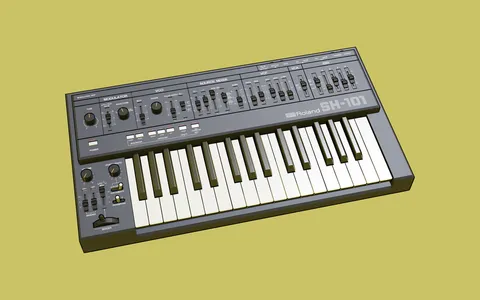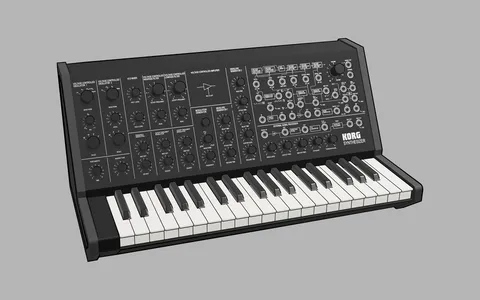
In the manga
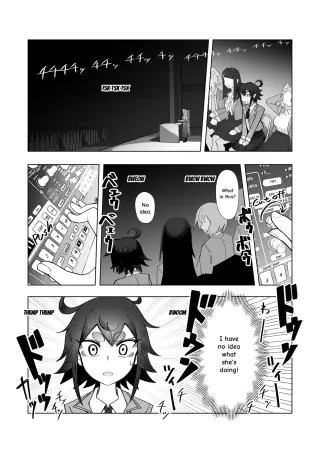
The club introductions in SIGNAL 1. Up on stage, Ikune-senpai turns the knobs on her gear, and the sound keeps changing: “BWOW BWOW,” “BWEOW” (see SIGNAL1 p.6 in the manga). Kohaku’s reaction from the audience: “I have no idea what she’s doing!” The knob Senpai was turning was the cutoff.
A little later, in SIGNAL 4, Senpai declares:

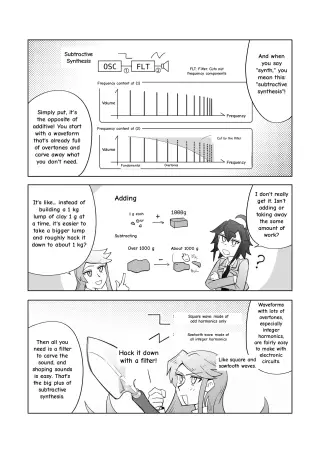
And when you say “synth,” you mean this: “subtractive synthesis”!
In this lesson we work out how subtractive synthesis works, and what Senpai was doing back then.
Carving instead of adding
Simply put, it’s the opposite of additive! You start with a waveform that’s already full of overtones and carve away what you don’t need.

I don’t really get it. Isn’t adding or taking away the same amount of work?
It’s like… instead of building a 1 kg lump of clay 1 g at a time, it’s easier to take a bigger lump and roughly hack it down to about 1 kg?
In the additive synthesis of LESSON 05, you needed one oscillator for every harmonic. With subtractive synthesis, you can get started with just one oscillator making a wave full of harmonics, and one filter to carve it. Without fussing over the fine details, a rough carve is enough to get a convincing timbre right away.
The raw material: waves full of harmonics
Waveforms with lots of overtones, especially integer harmonics, are fairly easy to make with electronic circuits.
These are the waves most often used as raw material for carving. You can check the harmonics of each one with the preset buttons in the demo in LESSON 03.
- Sawtooth wave: contains every harmonic, 2×, 3×, 4× and so on. A bright, flashy sound, used as the raw material for brass and strings.
- Square wave: contains only the odd harmonics. A hollow sound, close to a clarinet or a video game console.
- Triangle wave: odd harmonics only, like the square wave, but the high ones are much weaker. A soft sound, close to a sine wave.
They are easy to make with circuits because their shapes are simple. A sawtooth wave, for example, can be made just by charging a capacitor at a steady rate and letting it all go at once when it reaches a certain level, over and over. A square wave is just a switch flipping on and off, again and again.
One more raw material is noise. It is a hissing “shhh” that contains every frequency, and depending on how you carve it, it can become wind, waves, or the sizzle of a drum.
The filter: carving by frequency
A filter (FLT) is a circuit that weakens a certain range of frequencies. The kind synths use most is the low-pass filter: as the name says, it lets the low frequencies pass and carves away everything above a certain frequency. The frequency where the carving starts is the cutoff frequency, and the knob that moves it is the “cutoff.”
That is what Senpai was doing at the club introductions. Turn the cutoff while a note is playing and the high harmonics come and go, so the sound closes up into a muffled “bwow” or opens out into a “bweow.” She was moving only the timbre, without changing the pitch or the volume.
Besides the low-pass, there are other filters such as the high-pass, which carves away the low end, and the band-pass, which keeps only a certain range. Filters also differ in how steeply they carve above the cutoff. The 4-pole ladder low-pass filter that Senpai sighed she “wanted to tell you about, too” is a famous Moog circuit with transistors lined up like the rungs of a ladder. It is a very steep filter that cuts the level to about 1/16 for every octave above the cutoff.
Resonance: sharpening the edge of the cut
Filters often have one more knob, called resonance. It deliberately boosts just the frequencies around the cutoff. The higher you turn it, the sharper the edge of the cut becomes, and the sound takes on a strong, quirky character, a “nyow” or a “wheee.”
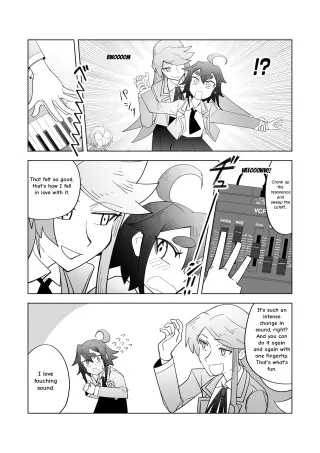
In SIGNAL 4, Senpai takes Kohaku’s hand and has her move the sliders while holding down a key.
Crank up the resonance and sweep the cutoff…
It’s such an intense change in sound, right? And you can do it again and again with one fingertip. That’s what’s fun.
Senpai goes on: “That felt so good, that’s how I fell in love with it,” and “I love touching sound.” Turning up the resonance and moving the cutoff is the most typical sound change on a subtractive synth. Be sure to try it in the demo below.
A two-oscillator subtractive synth
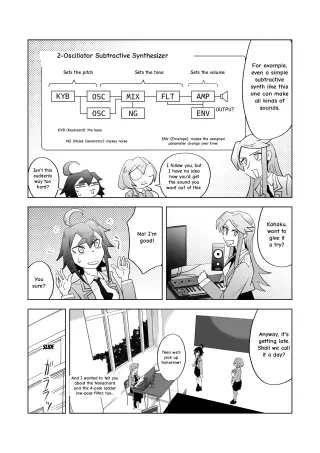
For example, even a simple subtractive synth like this one can make all kinds of sounds.
This diagram matches the three elements of sound from LESSON 02 one to one. The oscillators make a wave at the pitch chosen on the keyboard (pitch), the mixer blends and the filter carves (timbre), and finally the amplifier sets how loud it is (volume).
- With two OSCs, you can layer two pitches set slightly apart. The difference turns into beats, giving the sound thickness and movement.
- Mixing in the NG (noise generator) adds breathiness and a gritty texture.
- The AMP (amplifier) is the part that sets the volume. It also acts as a gatekeeper, letting sound through only while a key is held down.
ENV: moving things over time
The envelope (ENV) is, in Senpai’s words, the part that “makes the assigned parameter change over time.” It uses four numbers to decide how a value moves, from the moment you press a key until after you let go.
Connect it to the amplifier and it shapes the volume over time. You can make a note that rings out and dies away like a piano’s (sustain at 0), or one that stays at the same volume for as long as you hold the key, like an organ’s (sustain at maximum). Connect it to the filter and the cutoff opens and closes with a “wah” every time you play, a sound that is very typical of basses and synths. The idea from LESSON 03 that “timbre changes over time too” can be imitated with just four numbers.
Let’s play it
This synthesizer has the same layout as the diagram. To answer Teru’s “I have no idea how you’d get the sound you want out of this,” try these steps in order.
- Press “Auto-play” and slowly raise and lower the cutoff. You are doing the same thing Senpai did at the club introductions.
- Turn up the resonance, then move the cutoff again. That is the sound Kohaku experienced in SIGNAL 4.
- Press the “Bass” and “Pad” presets and compare how the four envelope values differ.
Play a subtractive synthesizer
This makes sound. Start with the volume low.Spectrum (green), filter shape (yellow)50Hz → 10kHz
Keys: mouse, finger, or the computer keys A W S E D F T G Y H U J K
Play the keyboard or press “Auto-play,” then move the cutoff and resonance while it sounds. On a computer you can also play with the A–K keys.
The green bars are the spectrum of the sound playing right now. The yellow line is the shape of the filter: move the cutoff or the resonance and it changes shape, and you can see that only the harmonics under it remain.
Controlling with voltage
The panel of the synth Senpai plays in the manga says “VCF.” That stands for Voltage Controlled Filter, a filter that is controlled by voltage. In the same way, there are VCOs (voltage-controlled oscillators) and VCAs (voltage-controlled amplifiers).
In an analog synth, the keyboard and the envelope both put out “voltage.” The keyboard’s voltage changes the oscillator’s pitch, and the envelope’s voltage moves the filter and the amplifier. By connecting the parts with voltage, the circuit could repeat automatically, as many times as you like, the moves you would otherwise make by turning knobs by hand.
Summary
- Subtractive synthesis creates a timbre by using a filter to carve unwanted harmonics out of a wave full of harmonics (sawtooth wave, square wave, noise).
- Lower the cutoff of a low-pass filter and the sound gets muffled; raise it and the sound gets brighter. Resonance sharpens the edge of the cut.
- The flow OSC (pitch) → FLT (timbre) → AMP (volume) matches the three elements of sound.
- An envelope (ADSR) adds change over time to the volume or the timbre.