
In the manga
In SIGNAL 5, Ikune-senpai’s fellow second-year, Isao-senpai, drops by the club room. When the talk turns to “PCM sound sources,” Isao-senpai says this.

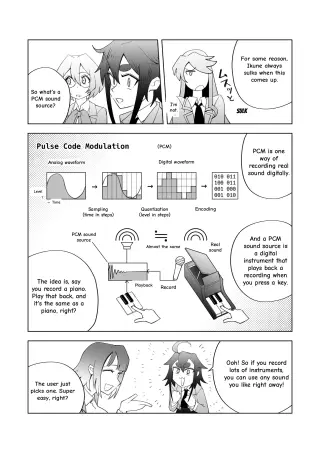
For some reason, Ikune always sulks when this comes up.
Senpai protests, “I’m not,” but the sulk is written all over her face. When Teru asks, “So what’s a PCM sound source?” Isao-senpai walks them through it.
PCM: turning sound into numbers
PCM is one way of recording real sound digitally.
PCM (pulse code modulation) was first devised for communications such as the telephone, and today almost all digital sound uses it: CDs, music on smartphones, recordings on computers and more. It takes the smooth, unbroken changes in air pressure we saw in LESSON 02 (the analog waveform) and turns them into a string of numbers in the three steps below.
The three steps of PCM
Sampling: slicing up time
The waveform is sliced at fixed intervals, and only the value at each instant is picked up. The number of slices per second is called the sampling rate. A CD uses 44,100 a second. With too few slices, fast waves (high sounds) slip through. The highest frequency you can capture is exactly half the number of slices. So to capture everything up to 20,000 Hz, the top of human hearing, you need to slice at least 40,000 times a second.
Quantization: rounding levels to steps
Each value you picked up is rounded to one of a fixed number of steps. The number of steps is given as a bit depth, and 16 bits means 65,536 steps. If the steps are coarse, the rounding errors come out as a hissing noise. Each extra bit doubles the number of steps and makes the noise about 6 dB quieter.
Encoding: turning it into 0s and 1s
The rounded step numbers are written in binary, using only 0 and 1. After that, you just store or send this string of numbers, and you can get the same sound back any time.
Turn sound into numbers (sampling and quantization)
This makes sound. Start with the volume low.Line: original · Dots: samples · Steps: digitalTime →
Encoding
Make the slices coarser or cut down the number of levels, and the sound turns gritty. A CD slices each second 44,100 times and records it in 65,536 levels (16 bits).
In the demo, make the slices coarser or lower the bit depth, and the sound crumbles into grit. That slightly rough texture in the sound of old game consoles and samplers is exactly this. Some music even enjoys this roughness on purpose.
PCM sound sources: playing recordings from a keyboard
And a PCM sound source is a digital instrument that plays back a recording when you press a key. The idea is, say you record a piano. Play that back, and it’s the same as a piano, right?

Ooh! So if you record lots of instruments, you can use any sound you like right away!
The user just picks one. Super easy, right?
The methods in the lessons so far all “made” the waveform with circuits. A PCM sound source records the sound of a real instrument ahead of time and “plays it back” when you press a key. Want a piano sound? Record a piano. Want drums? Record drums. It’s a very straightforward idea.
But building one that straightforwardly takes quite a few tricks.
- Play a recording faster and it gets higher; play it slower and it gets lower. But shift it too far and it sounds unnatural, like a sped-up voice. So you record every few notes and use the closest one.
- A piano’s tone also changes when you play harder, so you record at different playing strengths, too.
- Back when memory was expensive, long sounds couldn’t be stored in full. Instead, a part from the middle of the sound was played over and over (a loop) to make a held note.

Sounds easy to build, too.
The hardware is. But for high quality, the recording takes a ton of work. Still, they ended up way cheaper than analog synths.
From making sounds to picking them

That’s partly why the analog synth’s long winter set in…
So the age of making sounds became the age of picking them.
From the late 1980s on, keyboards with PCM sound sources, where realistic sounds are just a button press away, spread everywhere, and the analog synth, where you build a sound with knobs, stepped out of the spotlight. Senpai calls the stretch when hardly any new analog synths were made “the long winter.”
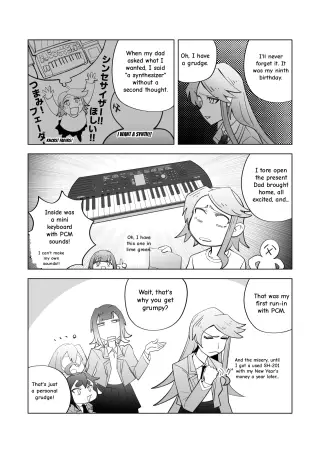
PCM is nothing but a glorified parrot!
A parrot is a bird that copies sounds and words it hears. Senpai’s point is that PCM is just good at playing back what was recorded; it doesn’t create any new sounds. Isao-senpai can only shake her head: “Is she living in the ’80s?”
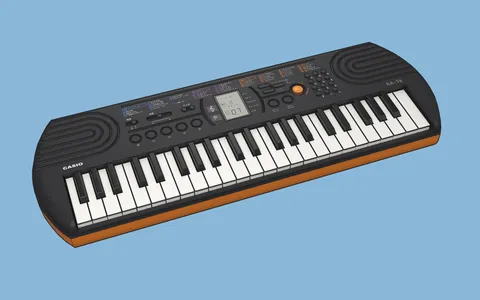
Senpai has her reasons for going this far. On her ninth birthday, she asked for “a synthesizer,” and what her dad brought home was a mini keyboard with PCM sounds (SIGNAL5 p.6). No knobs, no faders: you could pick sounds, but not make them. As Kohaku points out, it’s “just a personal grudge,” but it means Senpai knows firsthand the difference between an instrument that makes sounds and one that picks them.
Why PCM caught on
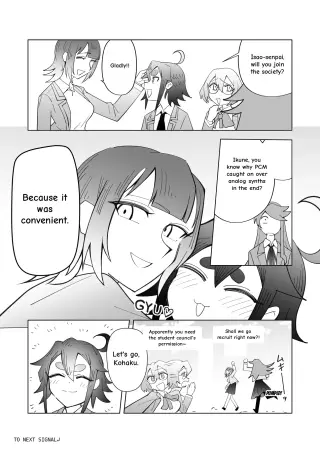
At the end of SIGNAL 5, Isao-senpai puts a question to Ikune-senpai.
Ikune, you know why PCM caught on over analog synths in the end? Because it was convenient.
That word “convenient” covers a lot of ground.
- For the makers: the only difference between sounds is the recorded data, so the same circuit can play any instrument. No parts to adjust, and it never drifts out of tune. The cheaper memory gets, the cheaper good sound gets.
- For the players: piano, strings, drums, all from one box, all sounding real. No need to learn sound design; just pick a sound and start playing or writing songs right away.
That convenience is why PCM spread to electronic pianos for the home (LESSON 01) and keyboards, and to the sound sources in game consoles and computers (LESSON 10). PCM also gave rise to ways of making sounds all its own, like “sampling,” where you cut up and rearrange recorded sound to make new music.
The winter didn’t last forever. From around the end of the 1990s, people rediscovered the fun of shaping sounds with knobs and the sound only analog circuits can make, and today lots of new analog synths are being made. Building on PCM recording technology, more methods for “making” sounds have appeared too, such as wavetable synthesis, which switches gradually between waveforms, and granular synthesis, which chops sound into tiny grains and rearranges them.
Summary
- PCM turns sound into numbers with sampling (slicing up time), quantization (rounding levels to steps) and encoding (turning them into 0s and 1s).
- A CD slices each second into 44,100 pieces and records at 16 bits (65,536 steps).
- A PCM sound source plays recorded instrument sounds from a keyboard. Just pick a realistic sound and play.
- It was “convenient” for both makers and players, so it spread, and the age of making sounds became the age of picking them.