In the manga
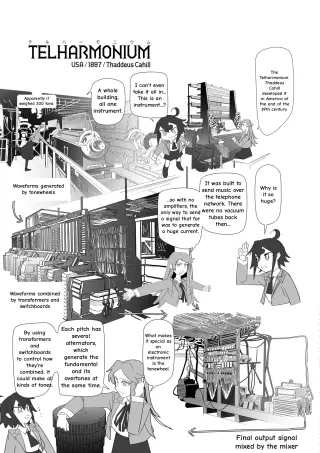
In SIGNAL 1, Ikune-senpai says that “the world’s first electronic instrument made its sound with motors, too” (see LESSON 01). Then she goes straight on to show a photo of a certain instrument.

The Telharmonium. Thaddeus Cahill developed it in America at the end of the 19th century.

I can’t even take it all in… This is an instrument…?
A whole building, all one instrument.
In this lesson we look, one by one, at the three old electronic instruments that appear in the manga: the Telharmonium, the theremin and the Ondes Martenot. They are all about 100 years old, but they are already packed with ideas that lead straight to today’s synthesizers.
The Telharmonium: an instrument the size of a building
The Telharmonium was patented in 1897 by Thaddeus Cahill in the United States. When the second model was finished, it weighed about 200 tons. Besides the console the player sat at, there were rows of generators and switchboards that filled whole rooms.
Why is it so huge?
It was built to send music over the telephone network. There were no vacuum tubes back then, so with no amplifiers, the only way to send a signal that far was to generate a huge current.
The Telharmonium sent live performances down telephone lines to homes and restaurants. It was a music streaming service, 100 years ago. Listeners are said to have played it through a telephone receiver fitted with a horn.
Tonewheels: spinning to make a wave
What Senpai says “makes it special as an electronic instrument” is the tonewheel. A metal wheel with bumpy teeth spins next to a magnet and a coil. Each time a tooth moves toward the coil and away again, the current in the coil rises and falls, and that creates an electrical wave.
Each pitch has several alternators, which generate the fundamental and its overtones at the same time. By using transformers and switchboards to control how they’re combined, it could make all kinds of tones.
An alternator is a generator like the tonewheel. Each pitch had one generator for the fundamental and others for the harmonics, and the timbre changed with how they were mixed. This is exactly the idea we saw in LESSON 03, “build a timbre by stacking pure tones,” and it is the method later called additive synthesis (see LESSON 05).
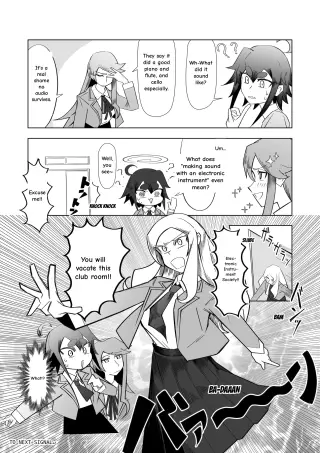
When Kohaku asks what it sounded like, Senpai answers:
They say it did a good piano and flute, and cello especially. It’s a real shame no audio survives.
With problems such as crosstalk on the phone lines, the business did not last long, and neither the machine nor any recording survives. But the tonewheel idea was passed on to the Hammond organ, which arrived in 1935, and it is still loved today as “the organ sound.”
Along came the vacuum tube
The Telharmonium was huge because there was no way to make an electrical signal bigger. When the triode vacuum tube arrived at the start of the 20th century, it became possible both to make a small signal bigger (amplification) and to create a wave inside a circuit (oscillation). No more spinning generators: a circuit alone could make the waveform. From here on, electronic instruments quickly became smaller and part of everyday life.
The theremin: played without touching
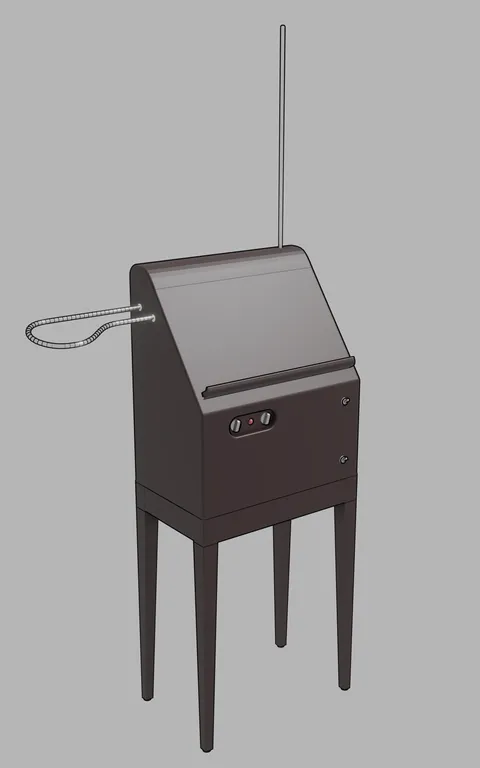
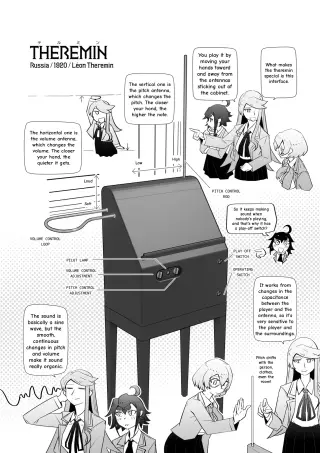
In SIGNAL 3, Senpai digs an instrument out of the club room that has the same name as Teru’s nickname: the theremin. It was invented around 1920 by Léon Theremin in Russia. The one in the club room is the production model made by RCA in the United States in 1929.
What makes the theremin special is this interface. You play it by moving your hands toward and away from the antennas sticking out of the cabinet.
The vertical rod is the pitch antenna: the closer your hand, the higher the note. The horizontal loop is the volume antenna: the closer your hand, the quieter the sound. You never touch the instrument at all.
Play the theremin
This makes sound. Start with the volume low.The closer you get to the rod on the right (the pitch antenna), the higher the note; the closer to the loop at the bottom (the volume antenna), the quieter. On a phone, trace with your finger.
Your hand becomes a capacitor
The human body conducts a little electricity, so your hand and the antenna act like a capacitor, the part that stores electric charge. The closer your hand, the larger this capacitance becomes, by a tiny amount. The antenna is part of an oscillator circuit (an LC oscillator, which makes a wave with a coil and a capacitor), so when the capacitance changes, the frequency of the wave it makes changes too.
But the change your hand makes is very small, so on its own it would hardly move the pitch at all. That is where a trick comes in, the one Teru spotted when she looked at the schematic: “Inside, it’s LC oscillators and heterodyning? Like an old radio.”
Heterodyne (example numbers)
Take two waves at frequencies too high to hear, and let your hand move just one of them. Mixing the two produces a wave at their difference in frequency. If oscillator B moves just 0.3%, from 300,000 Hz to 301,000 Hz, the difference swings all the way from 0 Hz to 1,000 Hz. A tiny movement of the hand is stretched out over several octaves of pitch.
It works from changes in the capacitance between the player and the antenna, so it’s very sensitive to the player and the surroundings.
As Senpai adds, “Pitch drifts with the person, clothes, even the room!” A theremin behaves differently just because someone else plays it or it is moved to another room. And as Kohaku noticed, it keeps sounding as long as a hand is near the antenna. That is why it has a switch to silence it when nobody is playing: the play-off switch. In the demo above, turn the switch off and a low note keeps sounding even after you take your hand away.
The sound is basically a sine wave, but the smooth, continuous changes in pitch and volume make it sound really organic.
Just as Teru said, “It just puts out a sine wave at a variable frequency, right?” The circuit itself is simple. But since there are no steps like the keys of a keyboard, vibrato and smooth slides from note to note are completely free. It can sing like a human voice or a violin, yet playing it in tune is very hard.
The Ondes Martenot: changing the timbre with loudspeakers
Next Senpai brings out one more: “Some instruments make sound on a similar principle but are totally different in how they shape it.”
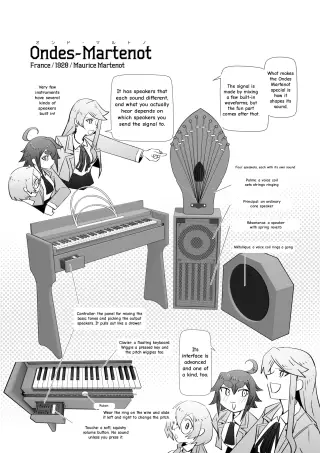
What makes the Ondes Martenot special is how it shapes its sound. The signal is made by mixing a few built-in waveforms, but the fun part comes after that.
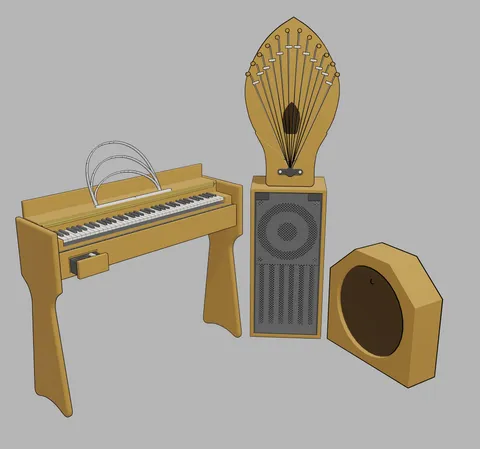
The Ondes Martenot was introduced in 1928 by Maurice Martenot in France. Like the theremin, it makes its waves with vacuum tubes, but it mixes several waveforms into the raw material for its timbre, and then lets you choose which of its speakers, each with its own sound, plays it.
- Principal: an ordinary cone speaker.
- Résonance: a speaker with spring echo attached (spring reverb).
- Métallique: sounds by making a gong vibrate, adding a metallic ring.
- Palme: a speaker strung with many strings. The strings resonate and add a harp-like shimmer.
Here “Résonance” is the name of a speaker. It is not the same thing as the filter “resonance” in LESSON 06, so don’t mix them up.
The way you play it is unusual too. Senpai says, “Its interface is advanced and one of a kind, too.”
- Clavier: the keyboard. Wiggle a key from side to side while holding it down and the pitch wiggles too.
- Ruban: you wear a ring attached to a wire and slide it left and right to change the pitch. The pitch glides smoothly, like a theremin’s.
- Touche: a volume button pressed with the left hand. No sound comes out unless you press it, and the deeper you press, the louder it gets.
Martenot, the inventor, was also a cellist. The touche recreates with a button the feel of changing the volume by how hard you draw the bow across the strings. In SIGNAL 3, Senpai says that to make a good electronic instrument, understanding sound and instruments matters more than electronics. The Ondes Martenot is still used in orchestras today, and you can hear it in works such as Messiaen’s Turangalîla-Symphonie.
Instruments from 100 years ago and the “three elements”
In LESSON 02, Senpai said that one kind of ideal instrument lets you put out the three elements of sound “freely, easily and quickly.” Look at the three instruments with that in mind:
- The Telharmonium tried to give you freedom over timbre through how the harmonics were mixed.
- The theremin let you change pitch and volume smoothly by moving your hands.
- The Ondes Martenot let you control timbre with waveforms and speakers, and pitch and volume with the keyboard, ribbon and button.
The instrument that lets you build all three elements freely with knobs and switches is the synthesizer, in the next lesson.
- 1897The Telharmonium is patented. A building-sized instrument that makes its sound with generators.
- c. 1906The triode vacuum tube is born. Now electrical signals can be made bigger, and waves can be created.
- 1920The theremin. A tube circuit makes the wave, and you play it by holding your hands near it.
- 1928The Ondes Martenot. Played with a keyboard and a ribbon, with loudspeakers that change the timbre.
- 1935The Hammond organ. The same tonewheels as the Telharmonium, shrunk to the size of furniture.
- 1960sThe age of the transistor. The synthesizer is born (LESSON 05).
Summary
- The Telharmonium (1897) made fundamentals and harmonics with generators called tonewheels, and mixed them to create timbres.
- With the vacuum tube, a circuit alone could make waves, and electronic instruments got smaller.
- The theremin (1920) uses the capacitance between hand and antenna, plus heterodyning, to control pitch and volume without being touched.
- The Ondes Martenot (1928) creates its timbre by combining waveforms and choosing speakers.
Pages in the manga: SIGNAL1 p.15SIGNAL3 p.8SIGNAL3 p.10