In the manga
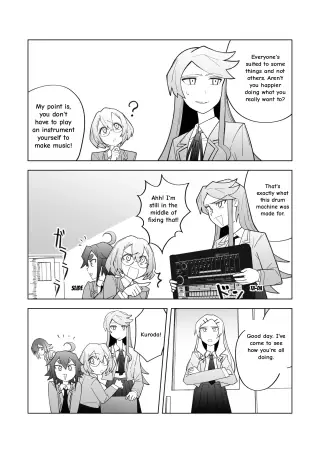
In SIGNAL 6, Ikune-senpai grabs the TR-808 that Teru is still in the middle of repairing and starts holding forth.

Everyone’s suited to some things and not others. Aren’t you happier doing what you really want to?
My point is, you don’t have to play an instrument yourself to make music! That’s exactly what this drum machine was made for.
With ordinary instruments, it goes without saying that you can’t make them sound unless you can play them. Electronic instruments turned that on its head. In this lesson, we’ll look at how music can play without anyone performing it.
Drum machine = sound source + sequencer
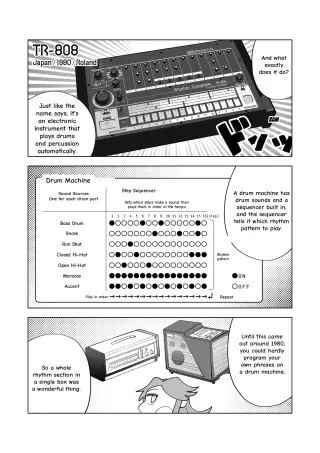
When Ginko, who has come to check on them, asks, “And what exactly does it do?” Senpai explains.
Just like the name says, it’s an electronic instrument that plays drums and percussion automatically.
A drum machine has drum sounds and a sequencer built in, and the sequencer tells it which rhythm pattern to play.
A drum machine is made of two parts.
- Sound source: the circuits that make the sound of each part, like the bass drum, snare and hi-hat.
- Sequencer: the part that remembers which sound to play at which moment, and gives the instructions in order.
In LESSON 01, we said that in an electronic instrument, the circuits that make the sound are separate from the part you operate. A sequencer is a machine that takes over that “part you operate” in place of a person.
The step sequencer
The TR-808’s sequencer is the kind called a step sequencer. As in the diagram in the manga, it divides one bar into 16 boxes called steps, and for each part you decide “play in this step (●)” or “don’t play (○).” Press start, and it moves through steps 1 to 16 at a set tempo, then goes back to 1 and repeats.
- One bar of 4/4 time is divided into 16, so each step is one sixteenth note. Every four steps make one beat.
- At a tempo of 120 (120 beats a minute), one beat is 0.5 seconds and one step is 0.125 seconds.
- The accent on the bottom row isn’t a sound. It’s an instruction to play the sounds in that step harder.
16-step rhythm machine
This makes sound. Start with the volume low.Press a square to switch it ON/OFF. On steps where the Accent row at the top is ON, the other sounds play louder. None of these sounds are recordings: they’re all synthesized electronically on the spot.
Start by playing the “8-beat” pattern, then try adding or removing steps one at a time. If you try these in order, you’ll see clearly how it works.
- Put the bass drum on every fourth step (1, 5, 9, 13) and you get the “four on the floor” of dance music.
- Put the snare on 5 and 13, and you get the rock and pop shape, where beats 2 and 4 are strong.
- Try putting an Open HH right after a Closed HH (hi-hat). When the closed one sounds, the open one stops, which is just how a real hi-hat behaves.
The TR-808’s sounds are “made” sounds
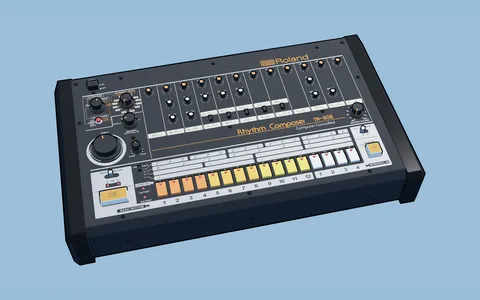
The TR-808 is a drum machine that Roland released in 1980. Its sounds aren’t recordings of real drums. Every one of them is a sound made by analog electronic circuits.
- Bass drum: give a circuit a quick tap, and it makes a sine wave that slowly fades away. The very start is a little higher in pitch.
- Snare: two pitched tones mixed with noise (LESSON 06).
- Hi-hats and cymbals: six square waves mixed together, with a filter that keeps only the high part. Square waves at odd, in-between pitches pile up into a metallic sound.
The sounds in the demo above are also synthesized on the spot along the same lines, without any recordings. Not much like the real thing, but fat, crisp and like nothing else. The TR-808’s sound later became essential to hip-hop, electro, house and more, and the manga calls it “probably the most-used drum sound of the last 40 years” (SIGNAL6 p.12).
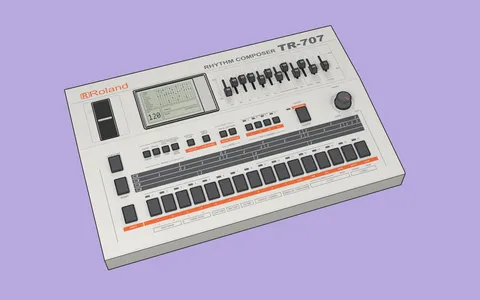
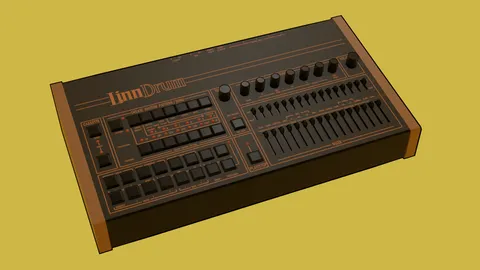
The LinnDrum, which came out a little later, was a high-end drum machine that played recordings of real drums (the PCM of LESSON 08). Roland’s own TR-707 also uses PCM sounds. “Made” sounds and “recorded” sounds each have their own appeal.
A rhythm section you can program freely
Until this came out around 1980, you could hardly program your own phrases on a drum machine.
Most rhythm machines before then were organ accompaniment devices: you picked a ready-made rhythm like “Waltz” or “Bossa Nova” and let it play. The TR-808 let you program every step yourself (it was fully programmable), and you could adjust the sound of each part, too. That’s why Senpai says “a whole rhythm section in a single box was a wonderful thing.”
You don’t have to play to make music
Sequencers aren’t just for drums. Back in SIGNAL 4, Senpai made this confession.
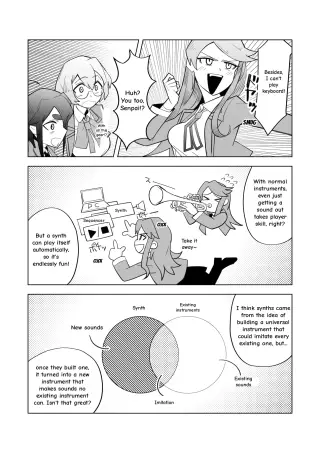
Besides, I can’t play keyboard!
Kohaku and Teru are stunned, and Senpai goes on.
With normal instruments, even just getting a sound out takes player skill, right? But a synth can play itself automatically, so it’s endlessly fun!
Melodies and bass lines work the same way: enter the pitch and length of each note into a sequencer, and the synthesizer plays them for you. The “Auto-play” in the demo in LESSON 06 is also a 16-step sequencer playing a synth. Even if your fingers can’t move fast, you can give shape to the music in your head.
Senpai also says, “I think synths came from the idea of building a universal instrument that could imitate every existing one, but once they built one, it turned into a new instrument that makes sounds no existing instrument can. Isn’t that great?” The TR-808, too, was built as a stand-in for real drums, yet it came to be loved for sounds real drums don’t have.
Toward an age of making songs alone at home
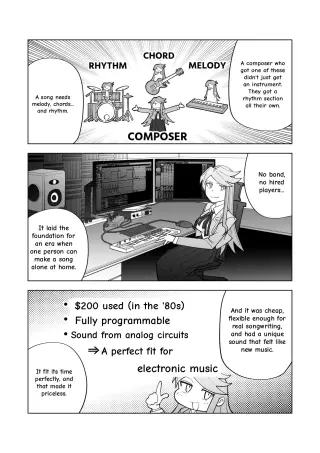
A composer who got one of these didn’t just get an instrument. They got a rhythm section all their own.
The TR-808’s panel reads “Rhythm Composer.” Senpai’s “composer” is a play on that name.
A song needs melody, chords… and rhythm. No band, no hired players… It laid the foundation for an era when one person can make a song alone at home.
Melody, chords (harmony) and rhythm are the “three elements of music” that came up in LESSON 02. With a sequencer, a synth and a drum machine, one person can supply all three. Senpai adds that the TR-808 was cheap (about $200 used in the ’80s), had enough freedom for real songwriting, and had a sound that felt like new music, and that this is why it fit its time so perfectly.
So how do you get several machines to all run together at the same tempo? The answer is MIDI, in the next lesson.
Summary
- A drum machine is made of a drum sound source and a sequencer that tells it when to play.
- A step sequencer divides one bar into 16 steps, sets each step ON or OFF, and plays them in order.
- The TR-808’s sounds aren’t recordings but sounds made by analog circuits. Sounds unlike the real thing gave birth to new music.
- Thanks to sequencers, you can make songs on your own even if you can’t play an instrument.