
In the manga
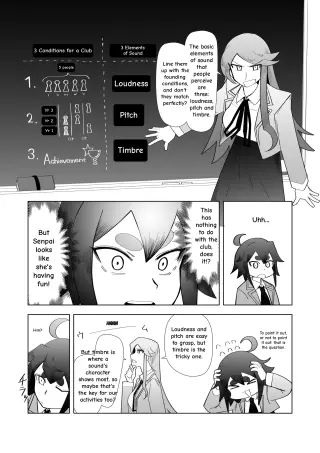
In SIGNAL 2, while writing the conditions for founding a club on the blackboard, Ikune-senpai for some reason starts talking about sound.

The basic elements of sound that people perceive are three: loudness, pitch and timbre.
Loudness and pitch are easy to grasp, but timbre is the tricky one.
It doesn’t seem to have anything to do with the club, but these three are the most basic foundation for understanding electronic instruments. In this lesson we’ll look at where each of the three shows up in a “sound wave.”
Sound is the air vibrating
Sound is really just the air vibrating. When a drumhead or a speaker moves back and forth, it pushes and pulls the air around it, and the dense and thin patches travel outward as a wave. When that wave shakes your eardrums, you sense that “there was a sound.”
Draw this change in air pressure as a graph, with time running across, and you get a waveform. Each of the three elements of sound shows up in a different part of the waveform.
Loudness (volume) is “amplitude”
The height of the wave’s peaks is called its amplitude. The harder the air is pushed, the bigger the amplitude, and the louder the sound. Loudness is usually measured in decibels (dB). Our ears judge loudness by “ratio,” not by “difference,” so doubling the amplitude only raises it by about 6 dB.
Pitch is “frequency”
The number of times a wave vibrates per second is called its frequency, measured in hertz (Hz). The faster the vibration, the higher the sound. The A that an orchestra tunes to is usually 440 Hz; double the frequency exactly, to 880 Hz, and you get the A one octave up. People can hear from roughly 20 Hz up to about 20,000 Hz.
Timbre is “the shape of the wave”
Even at the same loudness and the same pitch, you can tell a piano from a flute. That difference is timbre, and it shows up as a difference in the waveform’s “shape.” Just as Senpai says, it’s the “tricky one”: unlike loudness or pitch, a shape can’t be written as a single number. The next lesson unravels how it works.
Play with the three elements of sound
This makes sound. Start with the volume low.Time →
Change the volume and the wave gets taller or shorter; change the pitch and it gets finer or wider; change the timbre and its shape changes.
Summary: loudness = amplitude, pitch = frequency, timbre = the shape of the wave. Switch the View to Spectrum and you’ll see that a sine wave has a single bar, while the other waves have several bars in a row. This “row of bars” is the star of the next lesson.
The ideal instrument and the three elements
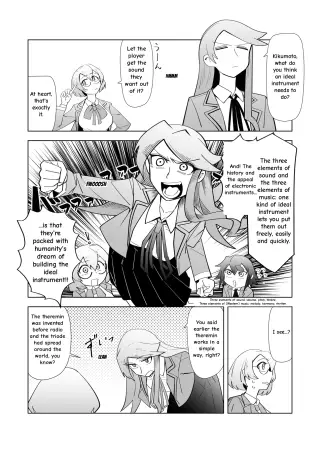
In SIGNAL 3, Senpai asks Teru, “What do you think an ideal instrument needs to do?”
The three elements of sound and the three elements of music: one kind of ideal instrument lets you put them out freely, easily and quickly.
The three elements of music are melody, harmony and rhythm. On an ordinary instrument you can’t, for example, change a violin’s timbre to sound like a piano. Electronic instruments have been built so that you can move the three elements of sound directly with knobs and buttons.
In fact, many synthesizers have a part in charge of each of the three elements: the oscillator sets the pitch, the filter carves the timbre, and the amplifier sets the loudness. We’ll put these three together in LESSON 06 (Subtractive Synthesis).
Next: what timbre really is
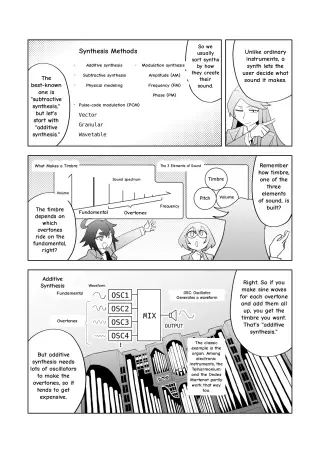
In SIGNAL 4, Senpai asks, “Remember how timbre, one of the three elements of sound, is built?” and Kohaku answers, “The timbre depends on which overtones ride on the fundamental, right?” (SIGNAL4 p.5). Kohaku had looked this up herself back in SIGNAL 2. In the next lesson, we’ll check her answer with our own ears.